

- Description
- Specifications
- Videos
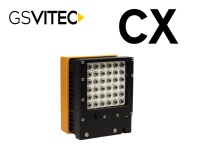
System overview of the GS Vitec LX Max High Pwer LED for high speed imaging
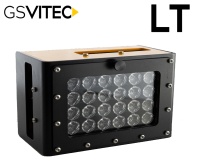
The GSVitec LT MAX is a high powered, flicker free continuous light fixture that is a perfect compliment to high speed cameras. The LAX MAX is equipped with 24 high power LEDs producing 24,000 lumens. This lap unit has a small form factor and only weighs 2.4lbs, has a long lifetime (50,000 hours plus) and a 2 year warranty. Optional longer cables or other cable types, hosuing varianton request.
Standard beam angle lenses are at 12° full working angle. A big plus for the MultiLED LT MAX is its versatility with exchangeable lenses with opening angles of 25° x 25°, 40° x 40°, 60° x 60°, 30° x 13°, 60° x 12°. This way, you only need one LED lamp that you can adjust to any situation, depending on which angle you need.
Available in:
- WHITE
- BLUE (440-460nm)
- PHOTO-RED (640-670nm)
MULTILED LT MAX - KEY FEATURES
|
|||||||||||||||||||||||||||||||||||
System overview of the GS Vitec LX Max High Pwer LED for high speed imaging
|
|||||||||||||||||||||||||||||||||||
| 24,000 Lumens | |||||||||||||||||||||||||||||||||||
| 240 Watts | |||||||||||||||||||||||||||||||||||
Related products
How to Pick the Perfect LWIR Camera: From Specs to Solutions
LWIR cameras offer 12.6 times faster snapshot speeds compared to MWIR InSb detector cameras, making them a game-changer for numerous applications.
When selecting the right thermal imaging solution, understanding the differences between cooled thermal cameras and uncooled thermal cameras can significantly impact your results. LWIR cameras excel in surveillance, homeland security, object detection, and various industrial and scientific applications. Furthermore, these powerful imaging devices can be packaged in something as small as a marshmallow, including the lens. What's equally impressive is that SLS cameras are 40 percent lower in price than comparable LWIR MCT cameras, though their performance capabilities vary widely depending on specifications.
From temperature ranges starting at -20°C and reaching up to 650°C without needing an ND filter, to cooled LWIR cameras that can lower sensor temperatures to extreme levels (as low as -321° Fahrenheit), the options can be overwhelming. Thermal camera resolution, sensitivity ratings (some with industry-leading sensitivity of less than 50mK), and wavelength considerations all play crucial roles in finding your perfect match.
Understanding LWIR Cameras
Long Wave Infrared (LWIR) represents a specific portion of the electromagnetic spectrum that opens up an entirely new way of seeing the world around us. Unlike visible light cameras that capture reflected light, LWIR cameras detect thermal energy emitted by objects, creating images based on temperature differences rather than color or brightness.
Cooled vs. Uncooled LWIR Cameras
Choosing between cooled and uncooled LWIR cameras represents one of the most critical decisions when selecting thermal imaging technology. The difference between these two types goes far beyond price points, ultimately determining what you can see, how clearly you can see it, and in what environments your camera will perform optimally.
How cooled LWIR thermal cameras operate
Cooled LWIR cameras incorporate specialized sensor cooling devices that dramatically reduce the sensor temperature to cryogenic levels. This extreme cooling serves a crucial purpose: it lowers the sensor temperature significantly below the thermal "noise" level, allowing the camera to detect minute thermal signals from the target without interference from surrounding heat.
Despite their impressive capabilities, cooled systems require periodic maintenance. The cryocooler typically needs rebuilding after 10,000 hours of operation as the helium gas gradually escapes past the seals and the mechanical components wear down.
Cooled thermal cameras primarily detect radiation through photon detection rather than temperature changes. Many utilize Mercury Cadmium Telluride (MCT) or Indium Antimonide (InSb) sensor materials, which offer exceptional sensitivity to tiny temperature variations. This operational principle enables them to capture remarkably detailed thermal images with extraordinary precision.
Uncooled LWIR cameras utilize microbolometer technology, measuring temperature changes in the infrared waveband without requiring cryogenic cooling. Most uncooled cameras employ either amorphous silicon (a-Si) or vanadium oxide (VOx) as the sensor material.
Choosing the Right LWIR Detector Type
The detector technology at the heart of your LWIR camera fundamentally determines its capabilities, limitations, and suitability for specific applications. Understanding the differences between available detector types enables you to make an informed selection based on your requirements for performance, cost, and operational conditions.
Microbolometers vs. SLS vs. MCT
Three primary detector technologies dominate the LWIR camera market, each with distinct characteristics:
Microbolometers represent the most common uncooled LWIR detector technology. These thermal detectors operate by measuring temperature changes in a thermistor material when heated by incident infrared radiation. Typically constructed with either amorphous silicon (a-Si) or vanadium oxide (VOx), microbolometers change resistance in response to absorbed thermal energy. This resistance change is measured, processed, and converted into a visible thermal image.
Microbolometers offer several practical advantages:
- Room-temperature operation without cooling requirements
- Lower cost compared to cooled alternatives
- Simplified maintenance with fewer moving parts
- Reduced power consumption
Nevertheless, they face significant performance limitations, predominantly due to their thermal time constant of about 10 milliseconds. This relatively slow response time restricts frame rates up to 60 Hz and makes them less suitable for high-speed thermal imaging.
Strained Layer Superlattice (SLS) detectors represent a more advanced technology that offers remarkable advantages for LWIR imaging. These cooled quantum detectors directly convert photons to electrons, enabling much faster response times—on the microsecond scale rather than milliseconds. SLS detectors operate in the 7.5-9.5 μm spectral range, allowing them to collect significantly more photons than MWIR detectors—a blackbody at 30°C emits nearly 10 times more photons in the 8-9 μm range than in the 4-5 μm range.
Mercury Cadmium Telluride (MCT or HgCdTe) detectors remain a popular choice for high-performance LWIR imaging. These photodetector arrays must be cooled to approximately 77K (-196°C) to function effectively. MCT detectors directly convert infrared photons into electrical signals, offering excellent sensitivity and fast response times.
Material impact on performance and cost
The materials used in LWIR detectors profoundly influence both performance and pricing considerations.
Microbolometer materials (a-Si or VOx) offer good thermal sensitivity at reasonable costs. These materials typically achieve thermal sensitivity (NETD) values around 40mK, suitable for many general-purpose applications. Their uncooled operation significantly reduces system complexity and maintenance requirements.
SLS technology utilizes artificial band gaps created in semiconductor heterostructures through lattice strain, causing major changes in electronic and optical properties. This approach offers several advantages over traditional MCT, namely:
- Better uniformity and stability through cooldowns
- 40% lower cost than comparable LWIR MCT cameras
- Shorter integration times than MWIR InSb detectors
- Ability to measure temperatures up to 650°C before requiring an ND filter
Frame Rate and Integration Time
Frame rate determines how many images the camera captures per second—a crucial consideration for monitoring dynamic scenes or rapidly changing thermal events. While standard LWIR cameras typically operate at 30-60 Hz (frames per second) as with the RADIA V60 LWIR camera, specialized high-speed models can achieve rates up to 1,012 Hz at full resolution in the Fast V1K LWIR Camera.
For truly demanding applications, some advanced cameras offer subwindowing modes that dramatically increase frame rates by using only a portion of the sensor. These can reach impressive speeds—up to 40,000 Hz when using a reduced 64×8 pixel window with either the Telops Fast V1K LWIR camera or the MS V1K Multispectral LWIR camera.
Integration time represents how long the sensor collects thermal data for each frame—similar to exposure time in conventional photography. Shorter integration times prevent motion blur when imaging fast-moving objects or rapid thermal events. The advantage of LWIR SLS cameras lies in their exceptionally short integration times compared to other infrared technologies producing crisp images of high-speed targets without blur that could otherwise compromise temperature measurement accuracy.
Sensitivity and Noise Performance
The performance of any LWIR camera fundamentally depends on its ability to distinguish tiny temperature differences—a capability that determines what you can see and what remains invisible. Understanding sensitivity metrics is crucial for selecting the right thermal imaging solution for your specific needs.
What is NETD and Why it Matters
NETD (Noise Equivalent Temperature Difference) represents the smallest temperature differential a thermal camera can detect amidst its own electronic noise. This critical specification measures a camera's thermal sensitivity in milliKelvins (mK)—with lower numbers indicating superior performance. NETD defines the minimum detectable temperature difference between an object and its background.
Industry professionals typically categorize thermal detector quality based on their NETD values:
<25mK: Excellent performance
<40mK: Great/Good performance
<50mK: Good/Acceptable performance
<60mK: Acceptable performance
<80mK: Satisfactory performance
Applications for LWIR Cameras
LWIR cameras have diverse applications, including security and surveillance, as they can see through smoke, dust, and darkness to detect heat signatures. They are also used in industrial settings for predictive maintenance by identifying equipment anomalies, in firefighting for locating hotspots, and in wildlife conservation and agriculture for monitoring animal movements and crop health. Other uses include medical fever screening and building energy management to spot insulation issues.
Security and Defense
Enhances situational awareness by identifying threats, monitoring perimeters, and supporting tactical missions’ day or night.
Firefighting and Search-and-Rescue
Cuts through smoke and haze to precisely locate people and heat sources.
Learn more on our Application Fields of Infrared Thermography for LWIR Cameras
Export Disclaimer: Some goods on this site may be subject to US Export Regulations. Buyer agrees as one of the terms of purchase not to export such goods without having obtained and executed proper export licenses from the United States Government. Learn more.
GS Vitec GmbH Lighting
MultiLed - Extreme Performance lighting for High Speed Cameras
GSVitec has been developing and selling high-speed and machine vision camera solutions for all industrial, research and military applications for over 20 years. Their complementary products and system solutions for high-speed camera applications have been used by customers in over 50 countries worldwide for many years. High-speed digital imaging requires extremely bright light levels for nanosecond shutter speeds for crisp and clear images. A suitable solution did not exist, GSVitec developed it.
MultiLED products cover all applications of high speed cameras and many applications in the machine vision market. Some models cover sub microsecond exposure time, monochromatic light or give you enough light to fully close aperture at microseconds of exposure time. Designed from a decade of experience with thousands of customer projects in mind, MultiLed products offer ultra strong lighting at an affordable price.
Custom lighting devices are in their DNA. From quantity 1 to several thousand units, GS Vitec offers the most advanced and powerful lighting for camera applications in machine vision and highspeed photography.