

- Description
- Specifications
- Videos
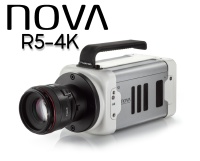
Photron FASTCAM Polaris F5 4K high speed camera captures 4,096 × 2,208 images at 5,000 fps, 4 times faster than our Photron FASTCAM NOVA R5-4K high speed camera. The defining feature of the Photron FASTCAM POLARIS F5 is its ability to preserve a large image area while recording thousands of frames every second built around a 12-bit backside-illuminated sensor. That combination suits tests in which reducing the field of view would hide part of the event. You can examine an entire specimen, spray plume, combustion region, or moving assembly without giving up the spatial detail needed for analysis. This industry leading 4K camera is powered by Pharsigthed revolutionary technology, making it the worlds fastest 4k high speed camera.
The Photron Polaris F5 uses a maximum image format of 4,096 × 2,208 pixels and records that full resolution at 5,000 fps. This provides approximately 9.0 megapixels per frame, while the common 3,840 × 2,160 UHD format provides approximately 8.3 megapixels. The POLARIS frame therefore contains roughly 9% more pixels than UHD 4K high speed cameras on the market. That difference affects how you design a test. The camera increases its recording rate at lower resolution; 10,000 fps at 2,560 × 1,664, 15,000 fps at 1,920 × 1,080, and 25,000 fps at 1,024 × 1,024. These modes let you match the recording speed to the event instead of operating every test at the largest image format. For example, full resolution provides the wider view needed for a complete test specimen. A 4-megapixel mode can capture a faster event while retaining substantial image area, and HD or 1-megapixel operation can record shorter-duration motion at much higher temporal sampling.
How POLARIS F5 Records and Saves Large 4K Image Sequences
The Photron Polaris F5 is available with either 216 GB or 432 GB of internal memory. These capacities give you two ways to configure the camera around the test sequence. The 216 GB version provides a lower-capacity option for applications with shorter events or smaller data requirements, while the 432 GB version retains twice the stated internal capacity for more demanding recording programs. That makes the Polaris F5 4k high speed camera suitable for installations where you need to capture a complete event before transferring data to a control computer and preserve the sequence for frame-by-frame review, measurement, and analysis after recording. A removable 1.6 TB U.2 NVMe SSD drive adds a separate, high-capacity destination for recorded image data and can reduce dependence on the camera’s internal memory for repeated test work. Its removable design also gives you a practical way to handle large datasets outside the camera system.
How the BSI Sensor Supports 4K High-Speed Image Quality
Backside illumination places the light-sensitive portion of the pixel where incoming light can reach it more efficiently. In practical terms, this architecture supports image capture when the exposure must remain short. The sensor architecture developed by Pharsighted determines whether a high-speed recording retains usable measurement detail, not only whether the camera reaches a specified frame rate. For the Photron FASTCAM Polaris F5 4K high speed camera, the relevant factors are photon collection, pixel sampling, read noise, and tonal resolution. Together, they explain why the Polaris F5 camera suits tests that require both a broad image area and short exposure times. For digital image correlation, smoother tonal separation helps the software follow surface patterns between frames. In combustion or flow imaging, it also gives you more intensity information across regions that would otherwise appear similar.
If you crop a full-resolution frame around a crack, impact zone, or fluid structure, more pixels remain available for measurement. Similarly, a larger test specimen can occupy the frame while retaining enough image detail for tracking, edge detection, or digital image correlation (DIC). Correlated Dual Sampling (CDS) is a function that takes the difference between the noise level and the luminance signal level of each pixel every frame. A 4K scientific high speed camera becomes more useful when the event covers a wide area rather than a small region at the center of the image. The 7.2 µm square pixels support this high-resolution format while preserving a practical sensor geometry for high-speed imaging also provides a defined balance between spatial sampling and light collection. In a test setup, you can choose between covering more of the subject and filling the frame with a smaller region. That flexibility is one reason the Photron Polaris F5 high speed camera suits applications that require both spatial and temporal resolution.
Additional features of the Photron FASTCAM Polaris 4K camera
You can configure the Photron FASTCAM Polaris 4K camera with F, C, Canon EF or RF, or M42 lens mounts.
Lens choice determines the field of view, working distance, and light reaching the sensor. For a wide test object, select a lens that covers the full 4,096 × 2,208 frame without unwanted cropping. For a smaller target, a suitable focal length can place more pixels across the measurement region. In either case, secure the lens and confirm focus at the intended working distance before the test begins.
The camera provides Start, Center, End, and Manual trigger modes. Start recording preserves frames after the trigger, while Center and End modes place the trigger within or near the end of the stored sequence. Manual triggering allows you to control the recording point from the test procedure.
Dedicated programmable inputs and outputs support triggering, synchronization, ready status, recording, exposure, and IRIG-related functions. You can therefore connect the camera to test equipment, lighting, or another camera. The external synchronization input accepts +3.3 to +5 V signals with switchable positive or negative polarity[1]. Before recording, match the signal polarity and voltage to the connected equipment, then verify the timing with a test pulse.
Camera control uses an RJ45 connection supporting 1, 2.5, 5, and 10GBASE-T communications. The higher-speed options can reduce transfer and control delays in a suitable network, while the computer, interface, switch, and cable must support the selected rate. For 10GBASE-T installations, use compatible network hardware and confirm stable operation before the experiment.
Integrated HD-SDI provides a dedicated video output for monitoring. This lets you observe the camera feed on a compatible display while the control computer handles setup and recording. Separating monitoring from network control also gives the operator a direct view of framing and focus.
The sealed camera body uses fan cooling for laboratory and industrial installations. Operating range is 0 to 40°C, so provide airflow around the housing and avoid placing heat-producing equipment directly beside it.
POLARIS F5 measures 240 × 212 × 175 mm, excluding protrusions, and weighs approximately 10.0 kg. Mount it on a support rated for the camera and lens, and check that the tripod, plate, fasteners, and panhead can carry the combined load. The camera requires 24 to 28 VDC and consumes approximately 215 W.
Target applications include:
- Automotive safety testing
- Solid Mechanics
- Fluid dynamics
- Defense and aerospace research
- Particle Image Velocimetry (PIV)
- Digital Image Correlation (DIC)
| 4096 X 2208 @ 5,000FPS | |
| 216GB or 432GB | |
|
9.0-megapixel BSI CMOS Image Sensor:
|
|
| 216GB or 432GB | |
| 1.5 μs | |
| 4K High Resolution | |
| 1Gb/10Gb Ethernet | |
| 12-bit | |
| Yes | |
| Global Electronic Shutter | |
| Backside-Illuminated CMOS Image Sensor | |
| 7.2μm x 7.2μm |
Related products



- Full Frame: 640 x 480 up to 489,000FPS
- 2,720,000fps
- 34ns minimum exposure time
How To Choose Your MWIR Infrared Camera
When it comes to selecting the right mid-wave infrared (MWIR) camera for your specific needs, understanding the technology and its applications is crucial. MWIR cameras are powerful tools that capture thermal images in the 3 to 5 micrometer wavelength range, making them ideal for various applications, including industrial inspections, scientific research, and defense surveillance. This guide will walk you through the essential factors to consider when choosing an MWIR camera, ensuring you make an informed decision.
What is MWIR?
Mid-wave infrared technology refers to the imaging capabilities that operate within the 3 to 5 micrometer range of the infrared spectrum. This range is particularly effective for detecting thermal radiation emitted by objects at moderate temperatures. MWIR cameras are designed to capture this thermal energy, converting it into visual images that can be analyzed for various applications.
How MWIR Cameras Work
MWIR cameras utilize a combination of lenses, thermal sensors, and processing electronics to create thermal images. The lens focuses infrared radiation onto the detector, which is typically an array of pixels. These detectors can vary in resolution, with common configurations being 320x256 and 640x512 pixels. The thermal energy absorbed by the detector is then converted into an electronic signal, which is processed to produce a visual representation of the thermal scene.
Advantages of MWIR Cameras
- Sensitivity: MWIR cameras are known for their high sensitivity, allowing them to detect subtle temperature differences in a scene. This is particularly beneficial for applications requiring precise thermal measurements.
- Versatility: These cameras can be used across various industries, including manufacturing, environmental monitoring, and military applications, making them a versatile choice for many users.
- Image Quality: The ability to capture detailed thermal images enables users to identify issues that may not be visible in the visible spectrum, such as heat leaks in buildings or overheating machinery.
Key Considerations When Choosing an MWIR Camera
1. Application Requirements
Before selecting an MWIR camera, it's essential to define the specific application for which it will be used. Different applications may require different features and capabilities. For instance:
- Industrial Inspections: If the camera will be used for detecting heat loss in buildings or monitoring machinery, high sensitivity and resolution are critical.
- Scientific Research: Researchers may need cameras with advanced features such as multispectral imaging or high dynamic range capabilities to capture a broader range of data.
- Defense Surveillance: In military applications, the ability to detect and identify targets at long distances is paramount, necessitating high-resolution imaging and fast frame rates.
2. Resolution and Sensitivity
The resolution of an MWIR camera determines the level of detail that can be captured in thermal images. Higher resolution cameras can provide more detailed images, which is crucial for applications requiring precise measurements. Additionally, sensitivity, often measured as Noise Equivalent Differential Temperature (NEDT), indicates the camera's ability to detect small temperature differences. A lower NEDT value signifies better performance, especially in applications where subtle temperature variations are critical.
3. Cooling Requirements
MWIR cameras can be categorized into two types based on their cooling requirements: cooled and uncooled. Cooled MWIR cameras typically require cryogenic cooling to operate effectively, which enhances their sensitivity but adds complexity and cost. Uncooled MWIR cameras, on the other hand, can operate at ambient temperatures, making them more compact and easier to use. When choosing a camera, consider the trade-offs between sensitivity and operational simplicity.
4. Environmental Conditions
The environment in which the MWIR camera will be used plays a significant role in the selection process. Factors such as temperature extremes, humidity, and exposure to dust or moisture can impact camera performance. Ensure that the chosen camera is rated for the specific environmental conditions it will encounter.
5. Budget Constraints
Cost is always a consideration when selecting any technology. MWIR cameras can vary significantly in price based on their features and capabilities. It's essential to balance your budget with the required specifications to ensure you get the best value for your investment. Consider not only the initial purchase price but also the long-term operational costs, including maintenance and potential upgrades.
Exploring Telops MWIR Camera Solutions
Overview of Telops
Telops is a recognized leader in the field of mid-wave infrared imaging technology, offering a range of innovative solutions tailored to meet diverse customer needs. Their MWIR cameras are designed with advanced features that enhance performance and usability across various applications.
Key Features of Telops MWIR Cameras
- High-Speed Imaging: Telops cameras are equipped with advanced imaging capabilities that allow for super high-speed thermal imaging, making them ideal for dynamic environments.
- Radiometric Calibration: Many Telops models feature proprietary radiometric calibration, enabling automatic exposure time adjustments for optimal image quality.
- Multispectral and High Dynamic Range: Telops cameras can capture images across multiple spectral bands, providing users with a comprehensive view of thermal data.
Popular Models
- Telops FAST Camera Series: This series is designed for high-speed applications, offering rapid frame rates and exceptional sensitivity, making it suitable for industrial and scientific research.
- Telops Radia: The Radia series is known for its versatility and reliability, providing users with robust thermal imaging solutions for various applications.
- Radia M100: This model is particularly well-suited for applications requiring high-resolution imaging and advanced thermal analysis capabilities.
Applications of MWIR Cameras
Industrial Applications
MWIR cameras are widely used in industrial settings for applications such as predictive maintenance, quality control, and process monitoring. By detecting temperature anomalies, these cameras can help prevent equipment failures and improve operational efficiency.
Environmental Monitoring
In environmental science, MWIR cameras play a crucial role in monitoring temperature variations in ecosystems, detecting gas leaks, and assessing the health of vegetation. Their ability to capture thermal data in real-time allows researchers to make informed decisions regarding environmental management.
Defense and Security
The military and security sectors utilize MWIR cameras for surveillance, target acquisition, and reconnaissance. Their high sensitivity and ability to operate in low-light conditions make them invaluable tools for ensuring safety and security.
Learn more on our Application Fields of Infrared Thermography for MWIR Cameras
Export Disclaimer: Some goods on this site may be subject to US Export Regulations. Buyer agrees as one of the terms of purchase not to export such goods without having obtained and executed proper export licenses from the United States Government. Learn more.