

- Description
- Specifications
- Videos
At the heart of the Photron Fastcam W5 high-speed camera sits a 2-megapixel CMOS sensor with global shutter technology. Unlike rolling shutters found in consumer cameras, this global shutter captures the entire frame simultaneously, eliminating distortion when filming rapidly moving objects. This becomes particularly crucial when recording events at extreme speeds, as even microseconds of difference between scan lines would render footage scientifically unusable. The sensor's 2MP resolution allows for impressive detail even when shooting at moderate frame rates, making this camera equally capable for both analysis and presentation-quality footage.
The Photron W5 high speed camera takes slow motion to an entirely new level. Acquisition rates of 5,000 frames per second at full 2 megapixel resolution. At reduced resolution, your can achieve 5,280 fps at 1920 x 1080, 8,000 fps at 1280 x 720, up to a maximum frame rate of 200,000 fps at 2048 x 8 resolution.
The W5 utilizes high-speed internal memory of either 16, 32, or 64 GB; that acts as a buffer for HD high speed recording. Since no current storage medium could write data fast enough at peak frame rates, the camera records to this buffer before transferring to permanent storage for analysis. Additionally, PFV4 assists with managing the massive datasets generated during recording sessions with PFA2 the ability to analyze the data in post.
Photron's PFV4 proprietary software suite handles the specialized file formats generated by the W5. Playback tools offer frame-by-frame scrubbing with microsecond precision, allowing me to identify exact moments of interest. The export functionality supports scientific formats alongside standard video formats. Color correction works remarkably well even with the challenging lighting conditions typical of high-speed videography. As an added benefit, batch processing capabilities streamline workflow when handling multiple test sequences.
Perhaps most impressive are the precision timing features. The W5 offers microsecond-accurate trigger response, which proves crucial when capturing fleeting events. Notably, the camera supports various triggering methods:
- External hardware triggers
- Software-based triggering
- Pre/post trigger buffering
The Photron W5 includes several professional connectivity options:
- Gigabit/10G Ethernet for control and data transfer
- External trigger ports for synchronizing with events
- Multiple camera sync capabilities for multi-angle capture
Multiple W5 units can be synchronized perfectly, allowing for multi-angle capture of high-speed phenomena without temporal discrepancies.
The Photron W5 now offers remotely controlled RF mount lenses. Using PFV4 software allows you to remotely control the lens aperture and focus from a PC. Some lenses also support zoom control, giving you greater flexibility. This is useful when access to the camera installation location is restricted or when the camera and control PC are located far apart. Other lens mounting options: G-type F-mount, C mount, EF mount, or M42 mount.
Photron provides a comprehensive 2-year standard warranty covering manufacturing defects. Extended warranty options stretch to 5 years. Technical support includes 24/7 emergency assistance and annual calibration services. Above all, Photron's reputation for reliable after-sale support enhances the overall value proposition.
Target applications include:
- Onboard and offboard automotive safety testing
- Biomechanics
- Life sciences
- Defence and aerospace research
- Material sciences
- Fluid dynamics / PIV
| 2,048 x 1,152 @ 5,000 FPS | |
| 64 GB | |
|
2.35-megapixel CMOS Image Sensor:
|
|
| 64GB | |
| 200,000fps | |
| 2μs | |
| 1Gb/10Gb Ethernet | |
| 12-bit | |
| Yes | |
| 10,000 | |
| 2,000 | |
| Global Electronic Shutter | |
| 13μm |
Related products


- Full Frame: 640 x 480 up to 489,000FPS
- 2,720,000fps
- 34ns minimum exposure time
Export Disclaimer: Some goods on this site may be subject to US Export Regulations. Buyer agrees as one of the terms of purchase not to export such goods without having obtained and executed proper export licenses from the United States Government. Learn more.
Understanding the Main Features of Cavitar’s CAVILUX Smart and CAVILUX HF Pulsed Illumination Lasers

Wavelength and Spectral Characteristics
The wavelength of illumination plays a crucial role in machine vision systems. Selecting the correct wavelength enhances image contrast and reveals specific features that might otherwise remain invisible.
The CAVILUX's monochromatic light eliminates chromatic aberrations commonly found in white light systems. Moreover, unlike coherent laser sources that produce speckle patterns, CAVILUX's low-coherence design delivers clean, speckle-free illumination while maintaining the benefits of laser light.
Different wavelengths offer distinct advantages in machine vision applications:
- Infrared illumination (like CAVILUX's 810 nm option) diminishes color effects in monochrome images, enhancing contrast of colored objects and simplifying inspection.
- Visible red light (640 nm in CAVILUX) provides excellent contrast for many applications where visible illumination is preferred.
Ultimately, the monochromatic nature of laser illumination also allows for efficient filtering of thermal light, enabling clear visualization of extremely hot processes like welding, where traditional lighting is overwhelmed by the process's own emissions.
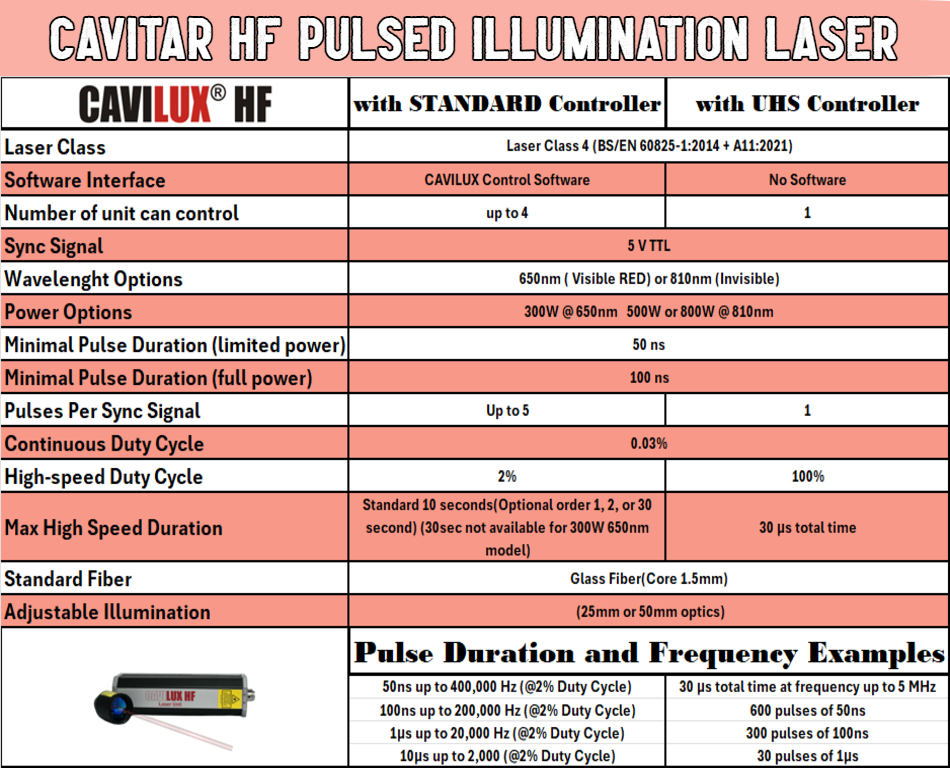
If visible light is necessary, then CAVILUX Smart 650nm and 300W CAVILUX HF 650nm is the standard products with visiable red illumination. The CAVILUX HF is equipped with a visible laser pointer beam (green light). Color cameras typically have an IR cut filter in front of the sensor which blocks 810 nm. Some cameras allow the removal of that filter and in this case CAVILUX 640nm and 810nm pulsed lasers can be used.
Fiber core diameter
CAVILUX Smart pulsed laser has a fiber core diameter of either 3mm or 5 mm, whereas CAVILUX HF pulse laser has a fiber core diameter of 1.5 mm. This means that CAVILUX HF has 4-11 times higher brightness than CAVILUX Smart. Higher brightness enables the illumination of a smaller area from a certain distance or, alternatively, the illumination of a certain area from a greater distance. CAVILUX Smart 200 W provides a higher brightness than CAVILUX Smart 400W if the illuminated area is smaller than 3 mm.
Motion Blur Reduction: 95% Improvement with Laser
Traditional lighting systems struggle with fast-moving objects, creating blurred images that lack precision. The CAVILUX laser system demonstrated a remarkable 95% reduction in motion blur compared to halogen illumination. This dramatic improvement stems from the laser's ability to generate extremely short pulses that effectively "freeze" motion regardless of camera shutter speed.
Unlike conventional lighting, where motion blur increases proportionally with object velocity, the CAVILUX system maintains image clarity at speeds that overwhelm traditional solutions. The laser pulses can be as brief as 50 nanoseconds, which is approximately 200 times shorter than the fastest exposure times achievable with most industrial cameras. Therefore, even when objects move at exceptional speeds, their positions remain fixed during the illumination period.
Minimum pulse duration
The minimum pulse duration for CAVILUX Smart enabling full output power is ~30 ns. CAVILUX Smart can create pulse durations up to 10 ns but then the output power is lower. The minimum pulse duration for CAVILUX HF at full power is ~100 ns and 50 ns at lower output power. A very short pulse may be needed for removing motion blur when a small and fast-moving object is studied at high magnification. CAVILUX Smart has shorter rise and fall times than CAVILUX HF. Therefore, Smart can generate extremely short pulses (below 100 ns) more accurately than CAVILUX HF.
The CAVILUX system's flexibility in pulse duration settings enabled optimization for different applications—shorter pulses for ultra-high-speed phenomena and slightly longer pulses for applications requiring greater illumination intensity. Indeed, the system demonstrated that in accordance with two-photon absorption principles, shorter pulses required significantly less average optical power to achieve equivalent visibility.
For real-time monitoring applications requiring continuous imaging, the laser's high maximum duty cycle supported frame rates up to several MHz for brief periods, outperforming traditional lighting solutions in both speed and clarity.
Maximum duty cycle
Due to the difference in duty cycles CAVILUX Smart laser is typically used together with machine vision cameras and CAVILUX HF laser with high speed cameras. CAVILUX Smart laser may also be compatible with certain ultra high speed cameras, depending on the application and camera with short record buffers.
As an example, if the object doesn’t emit thermal light and 100 ns pulses are sufficient for illuminating the object, CAVILUX Smart laser can provide optimal results up to 10 kHz, independent of the minimum exposure time of the camera.
However, if the object emits thermal light (e.g. arc welding), it is usually important that the laser pulse is of similar duration than the camera exposure time (and that the camera exposure time is properly synchronized with the laser pulse). In such a situation, having a camera of 1 µs minimum exposure time, CAVILUX Smart laser can provide optimal results up to 1 kHz (provided that the synchronization between the camera and the laser can be realized properly). Most likely acceptable results can be achieved also at somewhat higher frame rates (up to a few kHz), but the whole camera exposure time won’t be covered by laser illumination anymore (thus making the effects of thermal light stronger than in an ideal situation).
Applications:
Some examples of high-speed video cameras with short-pulse diode lasers include:
- Welding
- Additive manufacturing
- High voltage switching circuits
- Flow visualization
- Ballistics
- Impact visualization
- Shock wave analysis
- Spray visualization
- Schlieren
- Shadowgraphy