

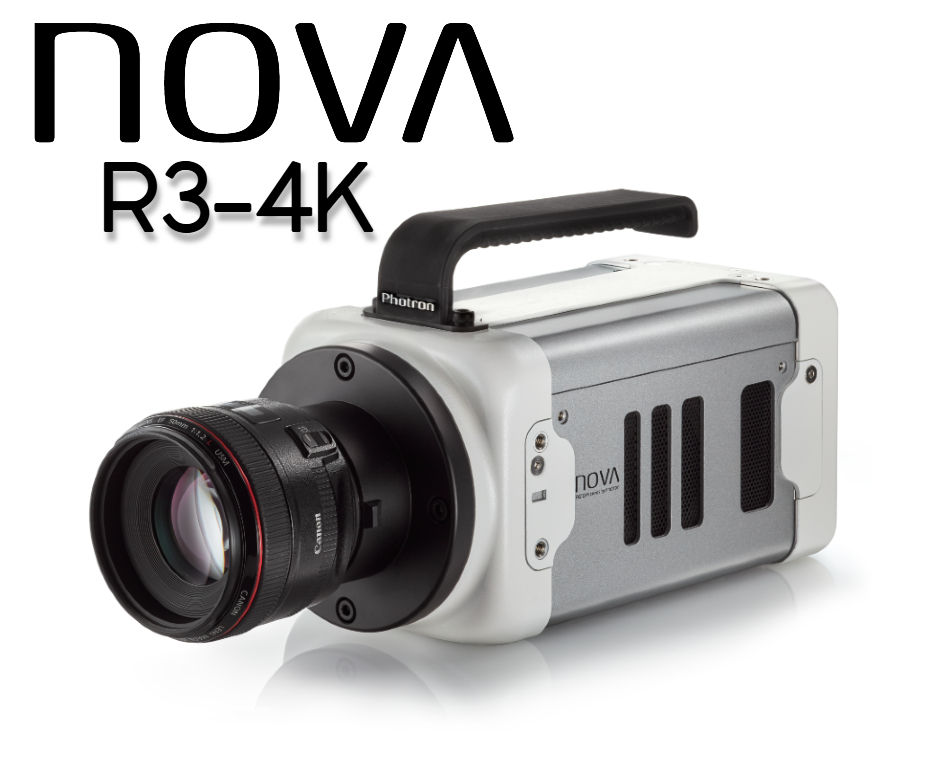
High-speed cameras are essential tools across research, manufacturing, and testing environments where events happen too quickly for the human eye or standard video to capture. Within Photron's lineup, the NOVA R Series stands out for prioritizing image resolution alongside frame rate. This combination is important with applications where spatial detail is just as important as temporal detail. The FASTCAM NOVA R3-4K delivers 4K recording at high speed in a compact, sealed enclosure built for demanding environments, and it serves as a strong introduction to what the R Series is designed to do.
What Is the Photron NOVA R Series
The NOVA R Series is Photron's resolution-focused line of high-speed cameras, designed for users who need to capture fine spatial detail during fast events. While many high-speed cameras prioritize raw frame rate above all else, the R Series is built around large-format CMOS sensors that maintain high pixel counts at elevated recording speeds. The current series includes four models: the NOVA R3-4K, NOVA R5-4K, Mini R3-4K, and Mini R5-4K. The NOVA models are full-size camera bodies, while the Mini variants offer a smaller form factor for applications where space and weight are constrained.
All cameras in the series share a common set of design principles: sealed body construction, 12-bit image depth, compatibility with multiple lens mounts, and integration with Photron's FASTCAM Viewer software and device control SDK. The differences between models come down to how much speed and resolution a given application requires.
FASTCAM NOVA R3-4K Specifications and Features
The FASTCAM NOVA R3-4K records 12-bit images at up to 750 frames per second at full 4K resolution (4096 x 2304 pixels), and 800 fps at UHD resolution (3840 x 2160). Its 9.4-megapixel CMOS sensor with a 6.5 micrometer pixel pitch provides more than twice the pixel count of many competing high-speed cameras at this price point. At 2048 x 2048, the R3-4K reaches 1,650 fps. At Full HD (1920 x 1080), it records at 3,000 fps. The camera reaches its maximum speed of 150,000 fps at a reduced resolution of 2048 x 8 pixels, and its minimum shutter speed is 2 microseconds.
Several hardware and software features make the R3-4K practical for both laboratory and field use:
- A sealed body prevents dust and corrosive particles from reaching internal electronics, which is important in industrial and outdoor testing environments
- An internal mechanical shutter allows remote system calibration without physically accessing the camera
- Memory segmentation lets users record into one partition while downloading from another, reducing downtime between tests
- A 10-Gigabit Ethernet interface supports fast camera control and high-speed image downloads
- Up to 128 GB of onboard RAM stores extended 4K footage, and an optional FASTDrive SSD supports image downloads at over 1 GB per second
The R3-4K includes Photron FASTCAM Viewer (PFV) software for camera control, playback, and basic analysis. It also includes a Device Control SDK with libraries for MATLAB and LabVIEW integration, allowing research teams to incorporate the camera into automated test sequences and custom analysis workflows. IRIG-B time synchronization support is built in for applications that require precise time-stamping across multiple data acquisition systems.
Why Resolution is Important in High-Speed Imaging
Frame rate often dominates the conversation around high-speed cameras, but resolution affects how much useful information each frame actually contains. A fast frame rate with too few pixels can capture an event without revealing the spatial detail needed to understand what happened. This tradeoff is especially relevant in measurement-intensive applications where the camera data feeds directly into quantitative analysis rather than simple visual observation.
Digital Image Correlation (DIC) is one of the clearest examples. DIC systems track a speckle pattern applied to a material surface to calculate full-field strain, displacement, and deformation during mechanical testing. DIC measurement precision and spatial resolution depend on how many pixels resolve the speckle pattern, along with speckle quality, subset size, optics, and image quality. A high-speed camera with 4-megapixel resolution at 1,440 fps gives DIC users significantly more spatial data to work with than a camera that achieves the same frame rate at 1 megapixel or less.
Particle Image Velocimetry (PIV) benefits from high resolution similarly. PIV maps fluid flow by tracking tracer particles across successive frames, and the ability to resolve individual particles at high density depends on having enough pixels to separate them clearly. Higher spatial resolution at a given frame rate can provide finer spatial sampling of the velocity field and improve the ability to resolve smaller flow structures, provided particle imaging, seeding density, interrogation-window size, and image quality are appropriate.
Beyond DIC and PIV, high-resolution, high-speed imaging supports better results in motion analysis, Schlieren visualization, crack propagation studies, and any application where spatial measurements are extracted from recorded footage.
Applications for the NOVA R Series
The combination of high resolution and high frame rate makes the NOVA R Series well suited for applications that require both temporal and spatial precision.
Materials testing and solid mechanics frequently involve high-speed deformation, fracture, and impact events. Researchers studying crack initiation in composites, fatigue behavior in metals, or impact response in protective materials need enough frames per second to capture the event and enough pixels per frame to resolve the failure zone in detail. The R3-4K's 9.4-megapixel sensor at 750 fps provides a strong baseline for these tests, and at 2048 x 2048 the camera reaches 1,650 fps for faster events where a square field of view is acceptable.
Automotive safety testing uses multiple high-speed cameras to document crash events, airbag deployments, seatbelt dynamics, and occupant motion. Resolution matters here because analysts need to track specific features, measure displacements, and verify component timing from the recorded footage. The R3-4K's Full HD recording at 3,000 fps covers many crash test requirements while preserving the image detail needed for post-test analysis, and its 4K mode captures the full width of a vehicle at a resolution that supports detailed frame-by-frame review.
Fluid dynamics research spans a wide range of speeds and scales, from slow mixing processes to supersonic jet flows. For studies using PIV, Schlieren imaging, or flow visualization, the R3-4K's resolution provides the spatial detail needed to resolve flow structures and particle distributions, while its 12-bit depth preserves the tonal gradations that distinguish subtle density changes in Schlieren setups.
Manufacturing process validation often requires high-speed imaging to diagnose problems on a production line or verify that a process runs within specification. Spray patterns, filling operations, welding processes, and packaging machinery all involve motion that happens too quickly for standard cameras. The R3-4K's sealed body and compact form factor make it practical to deploy near production equipment, and its lens flexibility allows it to adapt to different working distances and fields of view.
How 12-Bit Depth and Light Sensitivity Support Image Quality
The R3-4K records at 12-bit depth, which provides 4,096 levels of brightness per pixel compared to the 256 levels available in 8-bit systems. This wider dynamic range has practical implications for high-speed imaging, where lighting conditions are often challenging. High frame rates demand short exposure times, which can reduce the amount of light reaching the sensor per frame. With 12-bit depth, the camera retains more tonal information in both highlights and shadows, which helps preserve image quality when exposure times are pushed toward the 2-microsecond minimum.
This is particularly relevant for applications that involve bright, localized light sources alongside darker background areas. Welding, combustion, and plasma research all produce scenes with high contrast ratios where 8-bit recording would clip highlights or lose shadow detail. The R3-4K's 12-bit recording maintains a wider usable range across the entire frame, giving analysts more information to work with in post-processing.
The R3-4K is rated at ISO 3,200 in monochrome and ISO 640 in color, following the ISO 12232 Ssat measurement standard. Monochrome sensors are inherently two to three times more sensitive than color equivalents because they capture all incoming light without a Bayer color filter. For applications where color is not required, selecting a monochrome R3-4K maximizes the amount of light captured per frame, which is a significant advantage when working with short exposures at high frame rates.
Comparing the R3-4K to Other Current R Series Models
The current NOVA R Series includes four models, and the choice between them depends on how much speed, resolution, and physical flexibility a given application requires.
The NOVA R5-4K shares the same 4K sensor format as the R3-4K but offers higher frame rates: 1,250 fps at full 4K resolution (compared to 750 fps on the R3-4K), and up to 200,000 fps at reduced resolution (compared to 150,000 fps). For teams that need the fastest possible 4K capture, the R5-4K provides that additional headroom.
The Mini R3-4K and Mini R5-4K deliver the same sensor performance and frame rates as their NOVA counterparts in a smaller camera body. The Mini form factor is designed for applications where the camera must fit into tight spaces, mount on a moving platform, or be positioned close to a test subject. The tradeoff is that the Mini bodies have fewer onboard I/O options and may require an external processor or controller depending on the configuration.
All four models share 12-bit depth, 4K resolution, sealed body construction, the same lens mount options, and full compatibility with Photron's software ecosystem. The R3-4K offers the most accessible entry point to 4K high-speed imaging in the series, while the R5-4K and Mini variants serve teams that need higher speed or a smaller footprint.
Your Premier Source for High-Speed Imaging and Photron Cameras
If you are looking for custom-engineered high-speed cameras to meet your needs, our Tech Imaging team is here to assist you. To speak to one of our representatives, call 800-613-8180 or contact us online if you have questions.